
Dr. Guang Zheng is a Professor at the International Institute for Earth System Science (ESSI) at Nanjing University. Since receiving his Ph.D. from the University of Washington (UW) in 2011, he has focused on the intersection of forest ecology and remote sensing technology. His research leverages multi-platform LiDAR (spaceborne, aerial, mobile, and UAV) to characterize 3-D forest canopy structure. By analyzing the interactions between canopy structure and radiation regimes, Dr. Zheng aims to improve the accuracy of forest aboveground biomass estimation through the integration of remote sensing data with process-based ecological models. He has been working closely with the UW-Precision Forestry Cooperative (UW-PFC) and Remote Sensing and Geospatial Analysis Laboratory (UW-RSGAL) as Ph.D. student, visiting associate and full professors during the past decades.
Education background:
University of Washington (2011) Ph.D.
Nanjing University (2007) M.S.
Nanjing Forestry University (2004) B.S.E.
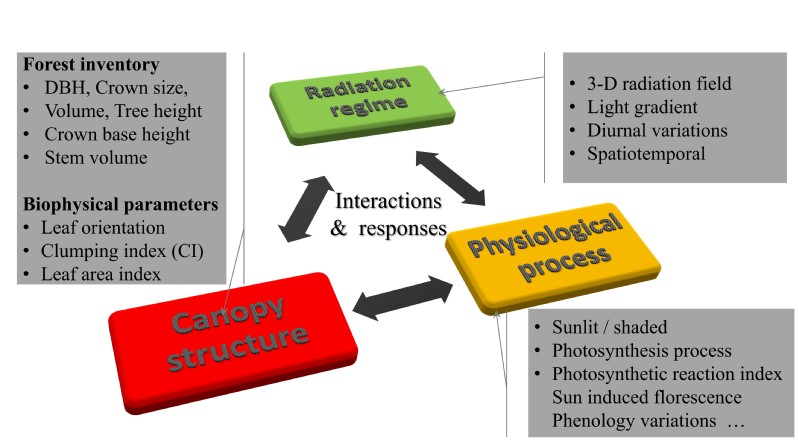
The triangular interaction framework between canopy structural characteristics, radiation regimes, and physiological processes in forest ecosystems. The canopy structure module serves as the structural foundation, characterized by forest inventory parameters (DBH, crown size, volume, tree height, crown base height, stem volume) and biophysical parameters (leaf orientation, clumping index, leaf area index). These structural attributes directly determine the radiation regime, which encompasses the three-dimensional radiation field, light gradients, diurnal variations, and spatiotemporal patterns within the canopy. The radiation distribution subsequently drives physiological processes, including photosynthetic mechanisms under sunlit/shaded conditions, photosynthetic reaction indices, sun-induced fluorescence, and phenological variations. Critically, the bidirectional arrows labeled Interactions & responses indicate that these relationships are not unidirectional—physiological processes can feed back to modify canopy structure (e.g., through leaf turnover, branch shedding), while the radiation regime continuously adapts to structural changes, creating a dynamic feedback loop that governs forest ecosystem function, carbon sequestration capacity, and climate response mechanisms.
LiDAR (Light Detection and Ranging) remote sensing serves as a critical bridge within this framework by providing high-resolution, three-dimensional quantification of canopy structural parameters. Through active laser scanning, LiDAR directly measures key forest inventory attributes (DBH, tree height, crown dimensions) and biophysical properties (leaf area index, clumping index) with unprecedented vertical resolution, thereby reducing uncertainty in the canopy structure module. Furthermore, when integrated with radiative transfer models, LiDAR-derived structural data enables precise simulation of the three-dimensional radiation field and light gradients, effectively linking the structural and radiative components while providing the spatial context necessary for scaling physiological processes from leaf to canopy level.